Every UAP event that has shaped the public record, in one place.
Government hearings, declassified documents, official reports, named witness testimony, and the major sightings that produced them — collected, dated, sourced, and organised so that they can be cited and compared.
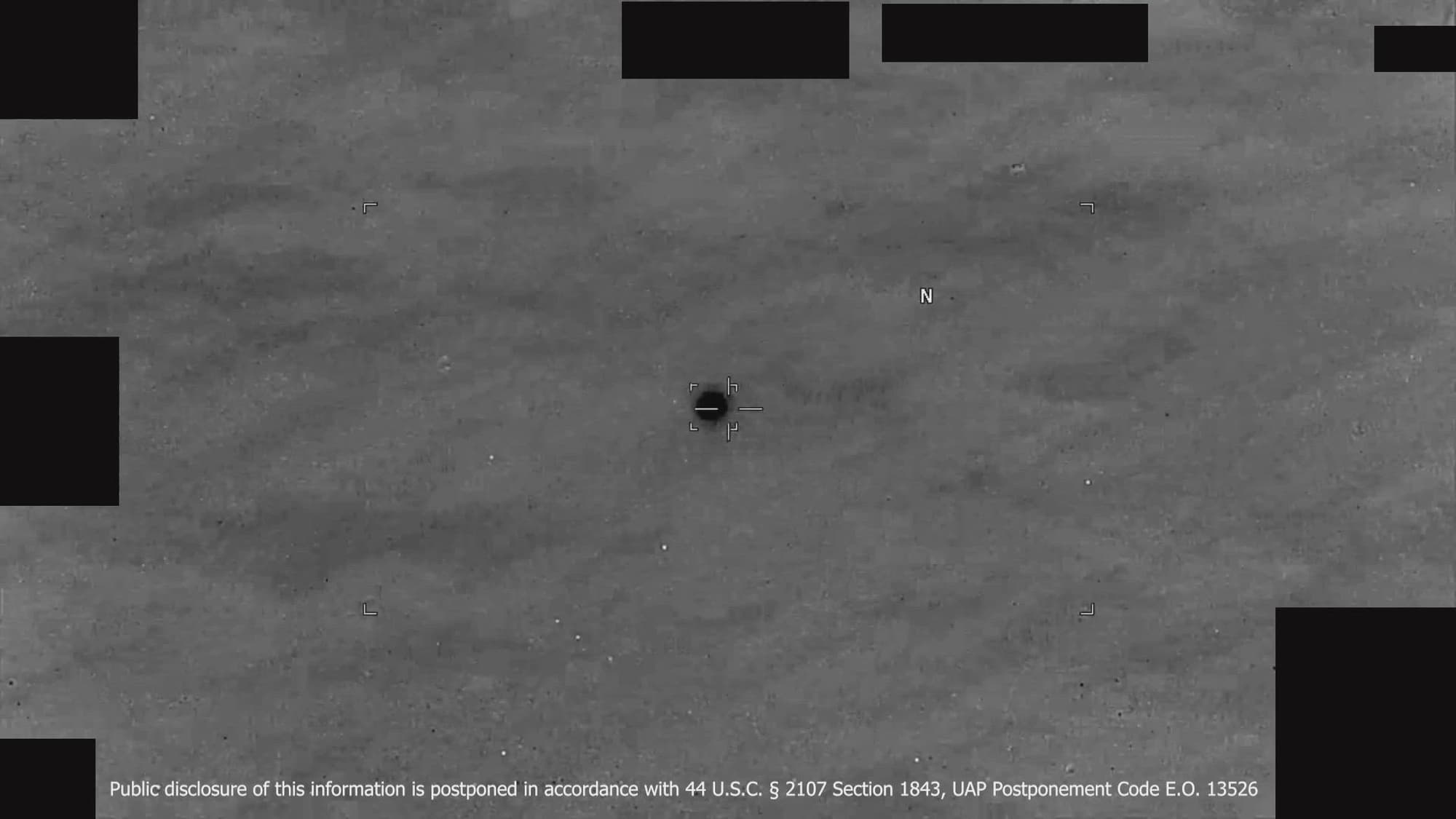
The sixth tranche of the Trump administration's PURSUE program puts the Defense Intelligence Reference Documents on the record: 37 of the 38 AAWSAP studies — warp drives, traversable wormholes, antigravity, negative mass, energy from the quantum vacuum — with the 2008 contract that commissioned them and the Department's own blunt assessments of each one. Also new: the 1952 Tremonton, Utah film with its Project Blue Book case file, Captain Edward J. Ruppelt's 1952 briefing on tape, the first local law enforcement files in the program, and ten CENTCOM and INDOPACOM sensor videos and stills. Four days earlier, the Department waived NDA penalties for insiders who bring UAP information to PURSUE.
"Silent, and featuring red, blue, and green flashing lights."
Releases 01–05 — the first 375 files (May 8, 2026 to August 7, 2026)
FBI bronze ellipsoid · Apollo 17 three-dot formation · the senior intel officer's orange-orbs narrative · the Lake Huron F-16 shootdown · the FBI's own agents' orb sightings · Senator Russell's 1955 Soviet sighting · the FBI triangle renderings · the 1963 Bahia crashed-sphere cables.
The U.S. Department of War is committed to releasing more PURSUE batches. Subscribe to be notified the moment each new tranche of declassified records goes public — with the standout files curated and the historical context built in.
~6 emails / year Free, no spam One-click unsubscribe
The sixth tranche of the Trump administration's PURSUE program: 72 files — 56 documents, 15 videos, 1 audio recording — bringing the public corpus to 447 files. Forty-four are the paper trail of AAWSAP, the DIA program behind the 'warp drive and wormhole' studies: 37 of its 38 Defense Intelligence Reference Documents, the 2008 Statement of Objectives, the solicitation and five contract modifications, each published with the Department's own assessment. Also new: the 1952 Tremonton, Utah film and its Project Blue Book case file, Captain Edward J. Ruppelt's March 1952 presentation on tape, the first local law enforcement files in the program, and ten CENTCOM and INDOPACOM sensor videos and stills.
The U.S. Department of War announced on September 15, 2026, a new legal waiver creating an authorized, legally protected disclosure mechanism for current and former government and military personnel to provide UAP-related National Defense Information (NDI) to designated representatives of the Presidential Unsealing and Reporting System for UAP Encounters (PURSUE). The waiver offers targeted relief from certain civil and administrative enforcement provisions contained in Non-Disclosure Agreements (NDAs) and Special Access Program Indoctrination Agreements (SAPIAs), and applies to Department of War service members, veterans, civilian employees, and contractors who hold or previously held access to UAP-related NDI.
The announcement represents a significant procedural development in UAP disclosure policy, addressing longstanding concerns from potential whistleblowers about legal and professional repercussions for discussing protected information. Critically, the waiver does not declassify any information; material submitted to PURSUE will undergo security review before any potential public release. The PURSUE initiative, launched earlier in 2026 by the Trump administration, is distinct from investigative bodies such as the All-domain Anomaly Resolution Office (AARO) and is focused specifically on identifying, reviewing, declassifying, and releasing UAP-related records held across U.S. federal agencies.
Four days before Release 06, the Department of War announces a targeted legal waiver: all current and former service members, civilian personnel and contractors who hold or once held UAP-related National Defense Information may disclose it directly to designated PURSUE representatives. The waiver supersedes the civil and administrative enforcement provisions of their non-disclosure agreements and Special Access Program indoctrination agreements — for communications to the PURSUE team only.
The Department of Defense issued a formal waiver on September 14, 2026, providing targeted legal relief to past and present civilian personnel, service members, and contractors who wish to disclose UAP-related information to representatives of the Trump administration's Presidential Unsealing and Reporting System for UAP Encounters (PURSUE). The waiver explicitly supersedes civil and administrative enforcement provisions in Non-Disclosure Agreements (NDAs) and Special Access Program Indoctrination Agreements (SAPIAs) executed in the United States, authorizing covered disclosures to PURSUE representatives without triggering breach-of-agreement penalties or standard NDA violations.
The action represents a significant policy development in the federal government's ongoing UAP transparency effort. PURSUE, which President Trump unveiled earlier in 2026, directs all federal agencies and military branches to aggregate internal UAP records for potential declassification and public dissemination. The waiver addresses longstanding concerns among potential whistleblowers — cited in the Pentagon's own press release — that legal liability, loss of clearances, or administrative prosecution under standard NDA and SAP indoctrination terms have historically prevented individuals from coming forward with UAP-related knowledge.
The Pentagon's All-domain Anomaly Resolution Office (AARO) has moved to issue a sole-source contract to the National Unidentified Flying Object Historic Records Center (NUFOHRC), a New Mexico-based nonprofit that holds what a Defense Department source described as the world's largest private collection of UAP-related historical records. Details of the planned commercial data subscription were first disclosed in a Defense Department contracting notice reported by DefenseScoop on September 2, 2026. The subscription would grant AARO digital access to NUFOHRC's proprietary data, metadata, and analytical products, with particular emphasis on materials predating 1990.
The move represents AARO's latest step to fulfill congressional mandates requiring a comprehensive review of U.S. government UAP involvement dating back to 1945, as directed by the fiscal year 2023 National Defense Authorization Act. NUFOHRC, founded and led by UAP historian David Marler, holds hundreds of thousands of unique case files — including the complete archives of early civilian scientific UFO research groups and personal files of Dr. J. Allen Hynek, who worked on the Air Force's Project Blue Book. The proposed contract structure includes a one-year base period with four one-year option periods; the total estimated cost was not disclosed.
A peer-reviewed preprint authored by physicist Shaun Fell of the think tank Applied Physics and Harvard astrophysicist Avi Loeb proposes that a subluminal warp drive spacecraft transiting Earth's atmosphere would produce extreme optical signatures — including luminosities exceeding one terawatt and air temperatures reaching 220 billion degrees Kelvin — that the authors argue are qualitatively consistent with categories of UAP phenomena described in recent Pentagon document releases. The study, published on the arXiv preprint server and reported by The Debrief on August 27, 2026, uses hydrodynamical simulations of airflow around theoretical warp bubbles based on the original 1994 Alcubierre metric and does not claim to prove the existence of extraterrestrial craft or alien life.
The paper's significance lies in its explicit linkage of established general-relativity mathematics to UAP observational data catalogued by the U.S. government. Loeb specifically cited an AARO report dated June 5, 2026, signed by AARO Director Dr. Jon Kosloski, which describes "an orange 'mother' orb launching smaller red orbs" and notes that 40 percent of phenomena in the reported event remain unresolved. The authors frame their findings as a testable scientific hypothesis, arguing that warp-drive physics can place "observational constraints" on UAP reports and narrow the range of viable explanations for the glowing orb phenomena most commonly documented in Pentagon releases.
A preprint study by Jacob Haqq-Misra of Blue Marble Space and Ravi Kopparapu of NASA's Goddard Space Flight Center, published in August 2026, analyzed all 112 UAP videos released by the U.S. Department of War under the Presidential Unsealing and Reporting System for UAP Encounters (PURSUE) since May 8, 2026. The researchers, both members of the UAP Science Advisory Council to the U.S. government, concluded that pervasive redaction of sensor data — particularly the range (distance) between observing platform and object — makes it impossible for civilian scientists to determine whether objects depicted in the footage display genuinely anomalous velocities.
The study, titled "Limits on Velocity Recovery from the PURSUE Sensor Videos" and posted to the arXiv preprint server, represents one of the first systematic scientific examinations of the PURSUE release corpus. It carries significance both for the UAP transparency debate and for the methodology of UAP science more broadly: the authors argue that apparent pixel-per-frame motion in infrared targeting-pod footage is not a reliable proxy for real-world object velocity without accompanying range data, platform trajectory, and camera field-of-view specifications. The researchers explicitly declined to draw extraordinary conclusions from the footage while also declining to dismiss the objects as mundane, and called for future releases to include unredacted or separately certified range measurements.
The fifth tranche of the Trump administration's PURSUE program: 41 files — 22 documents, 16 videos, 3 images — published 28 days after Release 04 and bringing the public corpus to 375 files. The organizing theme is triangles: four FBI interviews, each paired with a 2026 digital rendering, spanning a 2002 sighting over Bagram Air Force Base to two independent October 2023 reports from Colorado Springs. The release also contains the first FBI-captured video in the program's history and the first-ever State Department and Executive Office of the President files, tracking a 1963 Brazilian crashed-sphere claim to a fabrication within eleven days.
The Pentagon's All-domain Anomaly Resolution Office (AARO) released its Fiscal Year 2025 Consolidated Annual Report on Unidentified Anomalous Phenomena on or around July 21, 2026, disclosing that the office received 319 UAP reports between June 2, 2024 and May 30, 2025. Among the most notable disclosures is a single maritime-domain case involving a report from U.S. Navy assets operating off the coast of Virginia, describing approximately 100 airborne UAP and two likely uncrewed surface systems. AARO confirmed it is actively investigating the event in coordination with the reporting unit.
The 14-page report, mandated by the Intelligence Authorization Act for Fiscal Year 2023, also noted that AARO resolved 114 of the 319 cases — attributing them to balloons, birds, satellites, aircraft, unmanned aerial systems, a rocket launch, and a manned jet pack. As of May 30, 2025, the office's total case holdings stood at 1,870 reports. Officials also flagged two cases in which electronic or avionic interference was reported in proximity to operational aircraft, and reiterated that none of the resolved UAP cases to date indicate advanced foreign adversarial capabilities or breakthrough technologies. AARO additionally revealed it is developing a formal process for handling UAP-derived physical materials should such items come into government possession.
The fourth tranche of the Trump administration's PURSUE program: 40 files — 14 documents, 3 images, 19 videos, 4 audio files — bringing the public corpus to 334 files. Where Release 03 was the FBI's tranche, Release 04 is the historical one: a 1955 CIA debrief of four observers (one a sitting U.S. Senator) watching an object over the Soviet Union, the 1949 Los Alamos conference on 'green fireballs' attended by Manhattan Project physicists, Project Sign's founding 1948 progress report, and three NASA photographs of an unidentified object shot from Space Shuttle Columbia in 1996. Nineteen AARO sensor videos and four Apollo-era 'light flash' audio segments round out the release.
The United States Department of War (DOW) published its fourth official release of declassified UAP imagery and historical files on July 10, 2026, under the Presidential Unsealing and Reporting System for UAP Encounters (PURSUE). The release, announced by Chief Pentagon Spokesman Sean Parnell, includes several previously unseen U.S. military videos of unidentified aerial objects collected by the All-domain Anomaly Resolution Office (AARO), as well as historical documents dating to as early as the 1940s, all hosted at WAR.GOV/UFO.
The fourth PURSUE tranche is notable for the range of incidents represented, spanning imagery from the 1996 NASA STS-80 Space Shuttle Columbia mission, a 2019 Eastern United States sighting described by an observer with 28 years of combined U.S. Air Force and Navy experience, and multiple unresolved reports from 2020 over the Western United States and the Atlantic Ocean. Reporting by The Debrief's Micah Hanks notes that none of the released videos provide clear evidence of objects attributable to unknown aircraft or advanced technology, and that several are assessed as consistent with balloons or sensor artifacts. The DOW stated that additional file releases are being prepared on a rolling basis.
Harvard University theoretical physicist and Professor of Science Avi Loeb announced the formation of a new UAP Science Advisory Council on or around June 17, 2026, disclosing early details to DefenseScoop. The multidisciplinary council, comprising twelve named expert researchers spanning physical sciences, biology, psychology, and anthropology, is chartered to provide scientific guidance to the U.S. government's unidentified anomalous phenomena investigations and to advise on whether unexplained sightings constitute national security threats or represent novel discoveries. The council will report to a newly established interagency UAP Governance Board, co-established by ODNI, the FBI, and the Department of Defense, which held its first meeting on June 16, 2026.
The council's formation follows President Donald Trump's February 2026 directive instructing the Defense Secretary and relevant agencies to begin identifying and releasing government files related to UAP, aliens, and UFOs. Three batches of UAP files were released under that initiative on May 8, May 22, and June 12, 2026. AARO Director Jon Kosloski signed the most recent report, dated June 5, 2026, which described law enforcement officials observing an orange "mother" orb launching smaller red orbs during two days in October 2023, with approximately 40 percent of reported phenomena remaining unresolved. All data provided to the science council will be unclassified.
The U.S. Department of War released its third batch of UAP files on June 13, 2026, under the Presidential Unsealing and Reporting System for UAP Encounters (PURSUE). The release includes a previously undisclosed CIA document describing a disc-like object observed over Harare International Airport in Zimbabwe in 2008, reports of a translucent "potato"-shaped object seen near Cheyenne Mountain, Colorado Springs in 2024, and footage of apparent luminous orbs assessed by analysts to likely be sky lanterns. Pentagon spokesman Sean Parnell stated that WAR.GOV/UFO had received over 1.7 billion hits worldwide since its May 8, 2026 launch and confirmed that the Department of War and agency partners are actively preparing the next release.
The article, written by Micah Hanks of The Debrief, also highlights a video from the second PURSUE batch — designated DOW-UAP-PR061, "Spherical UAP [CALLSIGN] 2021/04/12 vid 0" — which captured on April 12, 2021 from a U.S. military drone operating within USCENTCOM's area of responsibility appears to show a small, light-colored spherical object descending, changing direction, and moving into shadowed terrain. Hanks argues this video, while not extraordinary, is consistent with AARO's own "target package" for genuine UAP as characterized by former AARO director Dr. Sean Kirkpatrick in April 2023, and raises the broader question of whether higher-quality UAP data that informed AARO's technical signature data remains classified and unreleased.
The third tranche of the Trump administration's PURSUE program: 72 files — 53 documents, 10 images, 6 videos, 3 audio files — bringing the public corpus to 294 files. The FBI dominates with 29 files, anchored by two modern American case clusters: a four-year series of orb sightings in the northeastern U.S. that the Bureau's own agents witnessed first-hand, and the first-person record of the October 2023 Western US Event. Also included: the CIA's 1953 Robertson Panel report in less-redacted form, NASA's Gemini-era crew debriefings, and the 1962 Cronkite–Cooper interview audio.
In June 2026, the International Academy of Astronautics (IAA) ratified a major update to its post-detection protocols governing the evaluation, verification, and public communication of potential extraterrestrial intelligence discoveries. Separately, the uNHIdden Foundation — a nonprofit focused on mental health related to Unidentified Anomalous Phenomena (UAP) — released what it describes as the first public-health preparedness framework addressing the societal impact of a paradigm-shifting disclosure event. Both developments were reported by The Debrief on June 11, 2026.
The IAA's revised declaration, led by Professor Michael Garrett of the IAA SETI Committee, updates protocols last adopted in 2010, expanding their scope to address deepfakes, AI-generated misinformation, social media, and the broadened technical landscape of modern SETI research. The uNHIdden Foundation's framework, launched June 8 by founder John Priestland and clinical spokesperson Dr. Martin Abbas, was developed by healthcare practitioners and public-health specialists to identify vulnerable populations and propose community-level resilience measures. While neither document constitutes a government action, both are intended to be shared with international bodies including the United Nations, and the IAA protocols are scheduled for formal presentation at the International Astronautical Congress in Türkiye later in 2026.
On June 9, 2026, UAP whistleblower David Grusch joined a bipartisan group of House members on the steps of the U.S. Capitol to demand that the federal government declassify and publish its records on unidentified anomalous phenomena. Reps. Anna Paulina Luna, Eric Burlison, Tim Burchett, and Jared Moskowitz appeared alongside investigative journalist Leslie Kean and documentary filmmaker James Fox, pressing Congress to pass the UAP Disclosure Act and to ensure that career intelligence officials do not obstruct the administration's declassification directive. At the lectern Grusch went further than usual on the nature of the phenomena, telling reporters the government is aware of 'several' kinds of non-human life, ranging from 'corporeal bipedal type life' to what he called 'sentient plasma life.'
No more than one or two emails a month. Each contains the new entries added to the timeline and a brief note on what they signify. Unsubscribe at any time.