Skip to content
Disclosure Archives
Latest release
September 18, 2026 · U.S. Department of War · 42 days after Release 05

PURSUE Release 06: the AAWSAP papers, the Tremonton film, and a police officer's fifteen minutes of video

Six weeks after Release 05 — and four days after the Department waived NDA penalties for anyone bringing UAP information to PURSUE — the Department of War published its largest tranche since June: 56 documents, 15 videos, and 1 audio recording. Forty-four of the files are the paper trail of AAWSAP, the DIA program behind the 'warp drive and wormhole' studies — published, for the first time, with the U.S. Government's own verdicts on them. The rest run from the most-argued-over film in Project Blue Book's history to a new agency category: local law enforcement.

"Silent, and featuring red, blue, and green flashing lights."
A Colorado local law enforcement officer's description of what he filmed in October 2023 — LLE-UAP-PR001, the first local law enforcement file in the PURSUE program, as summarised by the Department of War
Documents (PDF)
56
Videos
15
Audio
1
Total in this release
72

Cumulative across all six PURSUE tranches: 447 files in 133 days, per the live war.gov/UFO database. The Department says it and its agency partners "are actively working on the next release."

Why this release matters

The Defense Intelligence Reference Documents have been the subject's most-cited and least-read files since a 2019 DIA letter listed the 38 titles; the DIA released 37 of them to The Black Vault under FOIA in 2022. Release 06 publishes 37 of the 38 through PURSUE, with the July 2008 Statement of Objectives that scoped them — twelve technical areas 'out to the year 2050,' including 'spatial or temporal translation' and 'human effects' — the solicitation, the original order, and five contract modifications. The program they belonged to, AAWSAP, is the one whose existence surfaced through the December 2017 reporting on the Pentagon's UAP work.

The more consequential text is the Department's. Each DIRD ships with a summary, and the summaries do not hedge. The warp-drive paper 'relies entirely on unverified assumptions' and 'offers no viable engineering pathway.' The wormhole paper confirms 'the gap between theoretical models and any realizable technology remains enormous.' The 'maverick inventor' essay 'reflects a notable methodological circularity, validating the program's operational model rather than neutrally assessing the innovation ecosystem.' The human-tissue paper — reported injuries from close encounters mapped onto radiofrequency and microwave physiology — 'relies heavily on case comparisons lacking physical examinations, untestable exposure conditions, and a mix of established science and more controversial literature.' This is the U.S. Government grading its own contractor's homework, in public, and mostly failing it.

The historical prize is a film. On July 2, 1952, Delbert C. Newhouse, a Navy Chief Warrant Officer and career photographer, shot 12 to 14 bright objects over Tremonton, Utah, on 16mm Kodachrome. The Air Force called him honest, reliable and expert, then spent years failing to agree on what he had filmed — birds, balloons, mirage, 'pillow balloons' per a joint review with General Mills, seabirds per the later consensus. Release 06 has the National Archives digitization, the Blue Book case file with an AARO note untangling the 16mm/35mm confusion in the record, the balloon photo file, Newhouse's service record, and the Air Force's late-1952 'Flying Discs' compilation. The Navy's 1953 analysis of the same film arrived in Release 05.

And a new letterhead. Local law enforcement appears in PURSUE for the first time: a Colorado officer's four phone videos — one of them fifteen unbroken minutes — and a transcript of him narrating as he filmed, all submitted to AARO, all published with the lower half of the frame blurred and the Department's standing caveat about what phone autofocus does to distant lights. Add four CENTCOM Mission Reports paired with their imagery for the first time, six INDOPACOM clips from the Yellow Sea and East China Sea, and 65 minutes of Captain Edward J. Ruppelt explaining Project Blue Book to a Boston audience in March 1952, and the release is the broadest the Department has published.

One thing that is not in the files but frames them: on September 14, the Department issued a legal waiver releasing current and former service members, civilians and contractors from NDA and special-access-program penalties for UAP disclosures made to PURSUE representatives. Whatever that produces will not be in this tranche. It may be in the next.
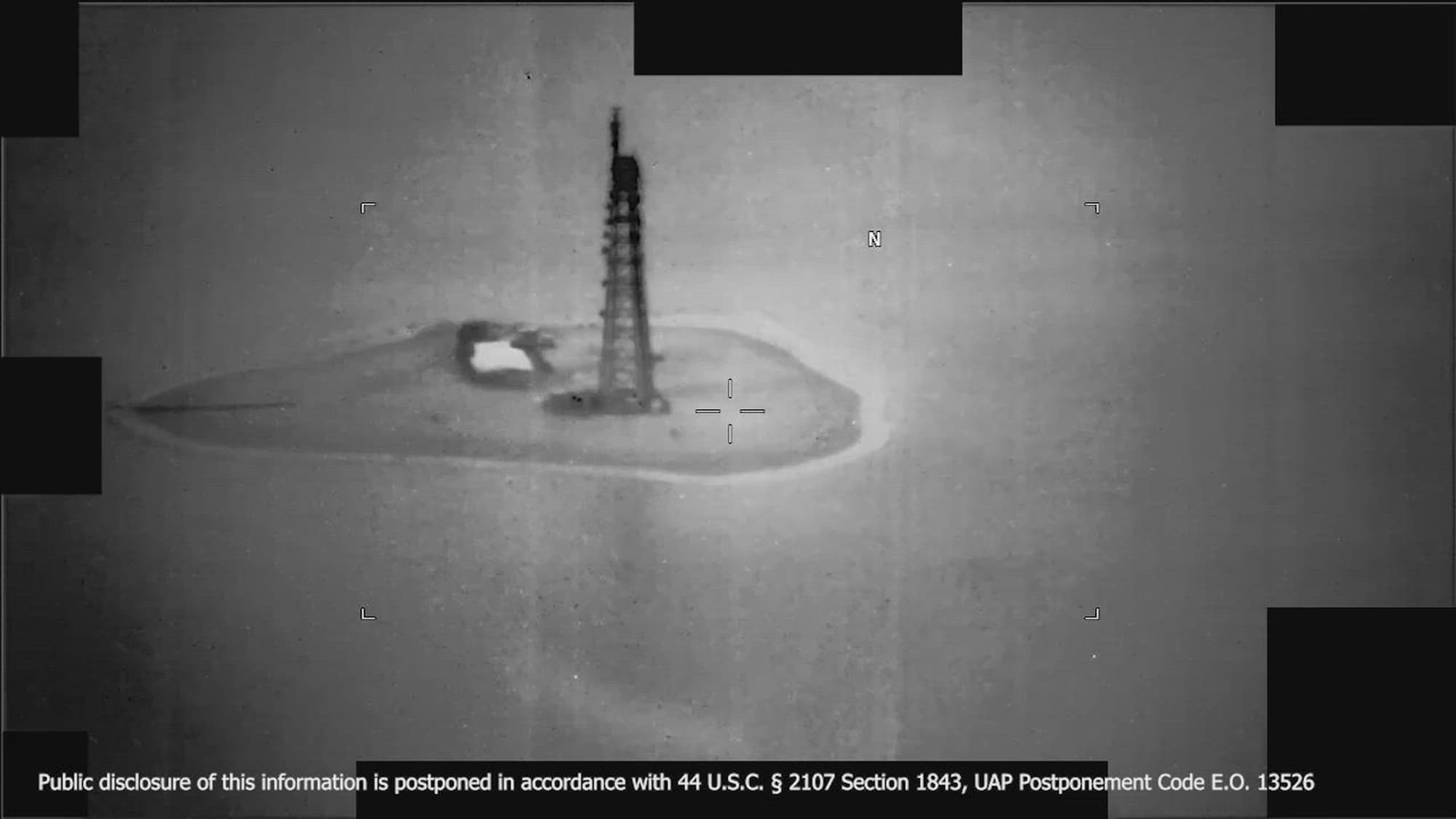
DOW-UAP-PR135 — a frame from a U.S. Central Command infrared sensor video in the Middle East in 2025, showing a lattice tower on a small island under the sensor's reticle. The accompanying Mission Report describes six small spherical objects grouped together, frequently changing direction, at an estimated 480 miles per hour.
DOW-UAP-PR135 · 2025 — the CENTCOM infrared clip paired with Mission Report DOW-UAP-D108, in which the operator reported 'six small spherical objects grouped together' that 'seem[ed] agile' and were 'frequently changing direction' at an estimated 480 mph.
PURSUE Release Alerts

Be on the list for PURSUE Release 07.

The Department of War is releasing on a rolling basis, every few weeks — and it has just opened a protected channel for insiders to come forward. Subscribe and get a fully-curated briefing the moment the next tranche goes live — every standout file surfaced, every agency tagged. Free. No spam.

~6 emails / year Free, no spam One-click unsubscribe

The 6 headline cases

Curated for newcomers — the cases that explain why Release 06 lands the way it does.

Seventy-two files on top of the 375 already public. These are the ones worth your first hour.

12008–2011

The AAWSAP papers: 37 'warp drive and wormhole' studies, and the contract that paid for them

The DIA released 37 of the 38 Defense Intelligence Reference Documents to The Black Vault under FOIA in 2022. Here they are through PURSUE — warp drives, traversable wormholes, antigravity, negative mass, invisibility cloaking, energy from the quantum vacuum — with the 2008 Statement of Objectives and every contract modification. The Department's own summaries are the story: 'no viable engineering pathway,' 'notable methodological circularity.'

Read the case
2July 2, 1952

The Tremonton film: Blue Book's most-analysed footage, released from the National Archives

On July 2, 1952, Navy Chief Warrant Officer Delbert C. Newhouse — a photographer with more than 1,000 hours of aerial-photography experience — filmed 12 to 14 bright objects over Utah. The Air Force called him honest, reliable and expert, then spent years deciding they were seabirds or pillow balloons. The film, the case file, the balloon photo file and Newhouse's service record are all here.

Read the case
3October 2023 – January 2024

A Colorado officer, a phone, and four videos: local law enforcement enters PURSUE

Five files from a new agency category. A local law enforcement officer filmed a silent object with red, blue and green flashing lights in October 2023 — one clip runs a full fifteen minutes — and again in January 2024, narrating as he recorded. AARO blurred the bottom of the frame and published the transcript with identifying details removed.

Read the case
42023

Six infrared clips from the Yellow Sea and East China Sea, 2023

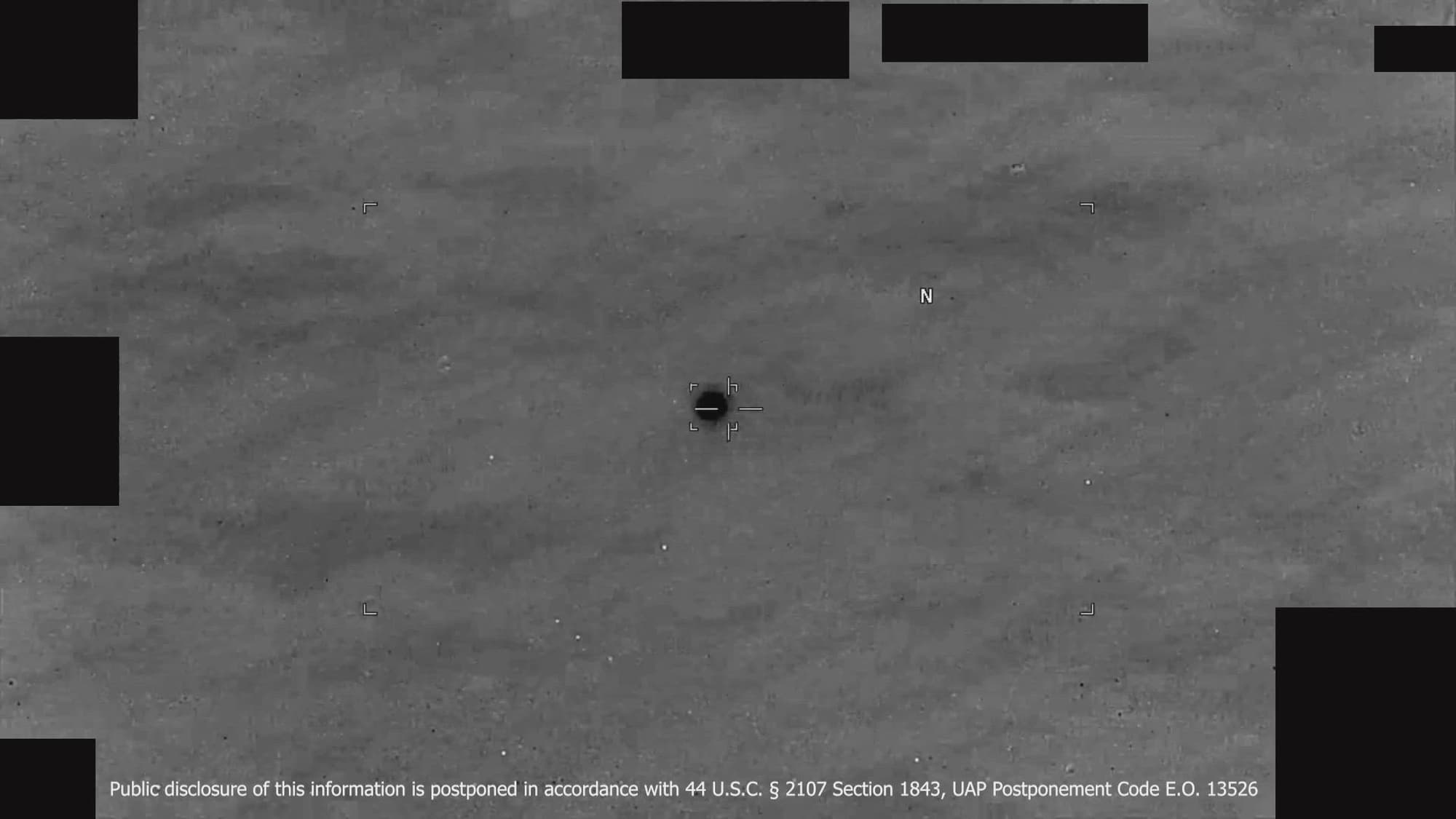
Indo-Pacific Command's contribution: six sensor videos, 19 seconds to 1 minute 38, each tracking a single area of contrast over open water. No mission reports accompany them. The iconic frame of this release — a black-hot object under the reticle — comes from the shortest of them.

Read the case
52022–2025

'Six small spherical objects': CENTCOM's mission reports and the footage behind them

Four Mission Reports and the imagery they accompany. An operator over Iraq in 2022 reported objects 'flying sporadically… between 80 and 180 miles per hour,' one to two metres across. In 2025 another described 'a white round orbit… moving as fast as 500 miles per hour,' and a third reported six spheres grouped together, changing direction at 480 mph. This is the first release to pair MISREPs with their footage systematically.

Read the case
6March 26, 1952

Ruppelt, on tape: the Blue Book chief's 1952 briefing, 65 minutes of it

Captain Edward J. Ruppelt told a Boston audience in March 1952 that roughly 20 percent of 800 Air Force cases remained unexplained, that reports clustered around Los Alamos, Albuquerque and Oak Ridge, and that radar had logged unconfirmed speeds of 1,000 to 3,500 mph. The transcript has circulated; the recording is new.

Read the case

In the live archive

These entries are individually browsable in the Disclosure Archives database, cross-tagged with pursue-release-06 and department-of-war.

Document Release
Featured

PURSUE Release 06: Department of War declassifies 72 more UAP files — the AAWSAP papers, the Tremonton film, and local law enforcement's first videos

The sixth tranche of the Trump administration's PURSUE program: 72 files — 56 documents, 15 videos, 1 audio recording — bringing the public corpus to 447 files. Forty-four are the paper trail of AAWSAP, the DIA program behind the 'warp drive and wormhole' studies: 37 of its 38 Defense Intelligence Reference Documents, the 2008 Statement of Objectives, the solicitation and five contract modifications, each published with the Department's own assessment. Also new: the 1952 Tremonton, Utah film and its Project Blue Book case file, Captain Edward J. Ruppelt's March 1952 presentation on tape, the first local law enforcement files in the program, and ten CENTCOM and INDOPACOM sensor videos and stills.

The Pentagon, Virginia — United States#AARO#Video Evidence#Law Enforcement#Project Blue Book
Official Statement

The Department of War waives NDA and special-access penalties for UAP disclosures to PURSUE

Four days before Release 06, the Department of War announces a targeted legal waiver: all current and former service members, civilian personnel and contractors who hold or once held UAP-related National Defense Information may disclose it directly to designated PURSUE representatives. The waiver supersedes the civil and administrative enforcement provisions of their non-disclosure agreements and Special Access Program indoctrination agreements — for communications to the PURSUE team only.

Sighting

'Six small spherical objects': four CENTCOM Mission Reports and the infrared imagery behind them, 2022–2025

For the first time PURSUE pairs U.S. Central Command Mission Reports systematically with their sensor imagery: four MISREPs, two infrared stills and four videos from Iraq and the Middle East. A 2022 operator reported UAP 'flying sporadically within the target area… at various speeds between 80 and 180 miles per hour,' one to two metres across. A 2025 operator described 'a white round orbit… moving as fast as 500 miles per hour.' Another reported 'six small spherical objects grouped together,' agile and frequently changing direction, at an estimated 480 mph.

Sighting
Featured

A Colorado officer's four phone videos: local law enforcement's first files in PURSUE

A local law enforcement officer in Colorado submitted four cell-phone videos to AARO — three from October 2023 and one from January 2024 — describing a 'silent' phenomenon 'featuring red, blue, and green flashing lights,' along with a transcript of his own narration as he recorded. The five files are the first from a local law enforcement agency in the PURSUE program. One clip runs a full fifteen minutes on a single light source. AARO blurred the lower half of each frame, edited the transcript to remove identifying detail, and attached its standing caveat about what phone autofocus does to distant subjects.

Colorado (location withheld), Colorado — United States#AARO#Video Evidence#Law Enforcement#Department of War
Sighting
Featured

Six infrared clips from the Yellow Sea and East China Sea: Indo-Pacific Command's 2023 sensor videos

U.S. Indo-Pacific Command's contribution to PURSUE Release 06: six infrared sensor videos recorded aboard U.S. military platforms in 2023 — five over the Yellow Sea, one over the East China Sea — between 19 seconds and one minute 38 seconds long, each tracking a single area of contrast over open water. No mission reports accompany them, and the Department's descriptions are confined to what the sensor does. The shortest, DOW-UAP-PR143, supplies the iconic frame of the release: one black-hot object under the reticle.

Yellow Sea — International waters#AARO#International#Video Evidence#Department of War
Document Release
Featured

The AAWSAP papers: 37 Defense Intelligence Reference Documents on warp drives, wormholes and antigravity — and the contract that paid for them

PURSUE Release 06 publishes 44 records of the Advanced Aerospace Weapon System Applications Program: the July 2008 Statement of Objectives, the September 2008 solicitation and original order, five contract modifications, and 37 of the 38 Defense Intelligence Reference Documents the DIA-administered program commissioned between December 2009 and January 2011. The famous titles are all here — Warp Drive, Dark Energy and the Manipulation of Extra Dimensions; Traversable Wormholes, Stargates and Negative Energy; Antigravity for Aerospace Applications; Negative Mass Propulsion; Concepts for Extracting Energy from the Quantum Vacuum — each with a Department of War summary that grades it, often harshly.

Sighting
Featured

The Tremonton film: Project Blue Book's most-analysed footage, released from the National Archives with its case file

On July 2, 1952, Navy Chief Warrant Officer Delbert C. Newhouse — a Photographer's Mate with more than 1,000 hours of aerial-photography experience — filmed 12 to 14 bright, reflective objects near Tremonton, Utah, on 16mm Kodachrome. The Air Force assessed him as honest, reliable and expert, and never conclusively identified the objects: birds, balloons and mirage early on; 'pillow balloons' after a December 1952 review with General Mills; seabirds reflecting sunlight in later assessments. PURSUE Release 06 publishes the National Archives digitization of the film, the Blue Book case file, the balloon photo file, Newhouse's personnel record, and the Air Force's late-1952 'Flying Discs' compilation.

Tremonton, Utah — United States#U.S. Navy#U.S. Air Force#Cold War#Video Evidence
Official Statement

Captain Edward J. Ruppelt's March 1952 briefing: 800 cases, 20 percent unexplained, radar tracks at 1,000 to 3,500 mph — now on tape

Three months before the Washington, D.C. flap, the head of the Air Force's reorganised UFO investigation told a Boston audience that roughly 20 percent of about 800 historical cases remained unexplained after technical analysis, that reports concentrated around Los Alamos, Albuquerque and Oak Ridge, and that radar had logged unconfirmed speeds between 1,000 and 3,500 miles per hour. PURSUE Release 06 publishes the transcript and a 65-minute audio recording of the presentation.

Boston, Massachusetts — United States#U.S. Air Force#Cold War#Radar Confirmed#Project Blue Book

Every file in PURSUE Release 06

The complete file catalogue, grouped by topical cluster and reconstructed from the war.gov/UFO database. All 72 files are works of the U.S. Federal Government (17 U.S.C. § 105) and are in the public domain. Document links resolve on the official war.gov medialink portal (Akamai protects the back end from programmatic fetches but resolves in the browser); videos and audio play on DVIDS. Several of the DIRD PDFs run to 50-100 MB.

AAWSAP, the paperwork: the 2008 Statement of Objectives, the solicitation, five contract modifications
Seven administrative records of the Advanced Aerospace Weapon System Applications Program, the DIA-administered effort active from 2008 to 2012. The July 2008 Statement of Objectives defines the program as a contractor-supported assessment of far-term foreign aerospace threats 'out to the year 2050,' across twelve technical areas — lift, propulsion, control, power generation, spatial or temporal translation, materials, configuration and structure, signature reduction, human interface, human effects, armament — with monthly status reports, program-management plans within 60 days, comprehensive research reports by the tenth month, and a final integrated threat assessment. The solicitation, original order and modifications P00001-P00005 track how the money moved. Read these before the DIRDs: they are the scope the studies were written against.
7 files
  • DOW-UAP-D110 — AAWSAP Statement of Objectives (July 18, 2008)
    DIA· July 18, 2008· Washington, D.C.

    The founding document. Twelve technical study areas, a 2050 horizon, and the deliverable schedule — including 'spatial or temporal translation' and 'human effects' as line items in a Defense Intelligence Agency statement of work.

  • DOW-UAP-D111 — AAWSAP solicitation and original order (September 22, 2008)
    DIA· September 22, 2008· Washington, D.C.

    The contract award, two months after the Statement of Objectives.

  • DOW-UAP-D112 — Contract modification P00001 (September 2, 2009)
    DIA· September 2, 2009· Washington, D.C.
  • DOW-UAP-D113 — Contract modification P00002 (February 2, 2010)
    DIA· February 2, 2010· Washington, D.C.
  • DOW-UAP-D114 — Contract modification P00003 (May 18, 2010)
    DIA· May 18, 2010· Washington, D.C.
  • DOW-UAP-D115 — Contract modification P00004 (May 18, 2010)
    DIA· May 18, 2010· Washington, D.C.
  • DOW-UAP-D116 — Contract modification P00005 (September 28, 2010)
    DIA· September 28, 2010· Washington, D.C.

    The last modification in the set, two years into the program.

The 37 Defense Intelligence Reference Documents: warp drives, wormholes, antigravity, and the human-tissue paper
Thirty-seven of the 38 DIRDs produced under AAWSAP between December 2009 and January 2011, each a technical reference document 'best understood as reference and synthesis products rather than as original research,' per the Department's own framing. The famous ones are all here: Warp Drive, Dark Energy and the Manipulation of Extra Dimensions (D138); Traversable Wormholes, Stargates and Negative Energy (D139); Antigravity for Aerospace Applications (D135); Negative Mass Propulsion (D152); Concepts for Extracting Energy from the Quantum Vacuum (D142); Invisibility Cloaking (D122); and Anomalous Acute and Subacute Field Effects on Human Biological Tissues (D128), the paper that tried to map reported injuries from close encounters onto known radiofrequency and microwave physiology. The Department's summaries are unusually blunt: D138 'offers no viable engineering pathway'; D134's argument for lone 'maverick' inventors 'reflects a notable methodological circularity, validating the program's operational model rather than neutrally assessing the innovation ecosystem'; D128 'relies heavily on case comparisons lacking physical examinations, untestable exposure conditions, and a mix of established science and more controversial literature.' Roughly half the set is conventional aerospace engineering — metallic glasses, ultracapacitors, hypersonic tracking, MHD propulsion, high-energy lasers — which is the point: the program's scope permitted 'a broad range of supporting topics.' All are dated from Las Vegas, Nevada.
37 files
  • DOW-UAP-D117 — DIRD: Metallic Glasses for Aerospace Applications
    DIA· December 14, 2009

    Surveys metallic glasses as a potentially important class of aerospace materials and describes their amorphous structure as offering very high strength and unusual manufacturing advantages, but also significant drawbacks, especially poor ductility and fatigue resistance.

  • DOW-UAP-D118 — DIRD: Aerospace Applications of Programmable Matter
    DIA· December 14, 2009

    Describes “programmable matter” as smart materials whose properties can be changed on command, potentially allowing spacecraft components to change function through software updates rather than physical repair or replacement.

  • DOW-UAP-D119 — DIRD: Biomaterials
    DIA· January 7, 2010

    Is a broad survey of biomaterials, including metals, polymers, ceramics, glasses, and composites designed to interact with living tissue, and argues that their value depends mainly on biocompatibility, reliability, and careful matching of material properties to specific medical uses.

  • DOW-UAP-D120 — DIRD: Materials for Advanced Aerospace Platforms
    DIA· January 12, 2010

    Surveys the structural materials needed for advanced aerospace platforms and argues that material choice cannot be separated from overall vehicle design, because launch vehicles, space vehicles, reusable systems, and propulsion hardware each face different temperature, durability, weight, and manufacturing constraints.

  • DOW-UAP-D121 — DIRD: Pulsed High-Power Microwave Source Technology
    DIA· January 28, 2010

    Surveys pulsed high-power microwave (HPM) source technology and argues that such systems remain of military interest because they can disrupt or damage electronic systems with short, intense electromagnetic pulses.

  • DOW-UAP-D122 — DIRD: Invisibility Cloaking Theory and Experiments
    DIA· March 2, 2010

    Surveys the theory and early experiments behind invisibility cloaking, describing several ways an object might be hidden from visual or sensor detection, including camouflage, transparency effects, and optical cloaking that bends light around an object.

  • DOW-UAP-D123 — DIRD: Positron Aerospace Propulsion
    DIA· March 2, 2010

    Examines positrons as a possible fuel for advanced aerospace propulsion, arguing that antimatter offers extraordinary energy density and could, in principle, support applications ranging from long-endurance aircraft and missiles to single-stage launch vehicles, onboard power systems, and crewed Mars missions.

  • DOW-UAP-D124 — DIRD: Space Access: Where We’ve Been and Where We Could Go
    DIA· March 8, 2010

    Is a historical and conceptual survey of space access systems, contending that the main barrier to routine access to space is a failure to build durable, reliable, operational hardware and the supporting infrastructure needed for regular service to and from low Earth orbit.

  • DOW-UAP-D125 — DIRD: Inertial Electrostatic Confinement Fusion
    DIA· March 10, 2010

    Surveys inertial electrostatic confinement (IEC) fusion, a relatively unconventional fusion concept that uses electric fields rather than the more established magnetic or laser-based approaches to confine ions, and it reviews both the underlying physics and the experimental work associated with the concept.

  • DOW-UAP-D126 — DIRD: Advanced Nuclear Propulsion for Manned Deep Space Missions
    DIA· March 11, 2010

    Examines advanced nuclear propulsion for crewed deep-space travel and argues that human missions beyond the Moon would require propulsion systems with both very high thrust and very high specific impulse, which the author contends are difficult to achieve with conventional chemical, nuclear-thermal, and nuclear-electric systems.

  • DOW-UAP-D127 — DIRD: An Introduction to the Statistical Drake Equation
    DIA· March 11, 2010

    Introduces the Drake Equation, a well-known thought framework for estimating how many communicative extraterrestrial civilizations might exist in the galaxy.

  • DOW-UAP-D128 — DIRD: Anomalous Acute and Subacute Field Effects on Human Biological Tissues
    DIA· March 11, 2010

    Surveys reported acute and subacute injuries allegedly associated with close exposure to anomalous field effects, attempting to draw tentative parallels between these claimed symptoms and the known physiological effects of intense radiofrequency .and microwave exposure on human tissue.

  • DOW-UAP-D129 — DIRD: Metallic Spintronics
    DIA· March 23, 2010

    Surveys metallic spintronics, a branch of electronics that seeks to use both the electric charge and the magnetic spin of electrons to store, detect, and manipulate information, and argues that the field could lead to faster, lower-power, and more radiation-resistant devices than conventional semiconductor electronics.

  • DOW-UAP-D130 — DIRD: Technological Approaches to Controlling External Devices
    DIA· March 23, 2010

    Surveys brain-machine interface technologies intended to allow users to control external devices without conventional manual controls, and it evaluates both noninvasive and invasive approaches for turning neural or related physiological signals into usable commands.

  • DOW-UAP-D131 — DIRD: The Role of Superconductors in Gravity Research
    DIA· March 23, 2010

    Is a historical survey of efforts to determine whether superconductors might play a role in producing, detecting, or modifying gravity-related effects in a laboratory setting.

  • DOW-UAP-D132 — DIRD: Advanced Space Propulsion Based on Vacuum (Spacetime Metric) Engineering
    DIA· March 29, 2010

    Examines the idea of vacuum or spacetime-metric engineering: the possibility that an unspecified future technology might alter the structure of spacetime in ways useful for propulsion, power generation, or extremely rapid long-distance travel.

  • DOW-UAP-D133 — DIRD: The Space Communication Implications of Quantum Entanglement and Nonlocality
    DIA· March 30, 2010

    Reviews quantum entanglement and nonlocality with a focus on whether those phenomena might be usable as a means of faster-than-light communication between observers, especially for real-time space operations over interplanetary distances.

  • DOW-UAP-D134 — DIRD: Maverick Inventor Versus Corporate Inventor: Where Will the Next Major Innovations Arise
    DIA· March 30, 2010

    Compares lone “maverick” inventors with researchers working inside larger organizations in order to ask where major future breakthroughs are most likely to come from, especially in unconventional energy and propulsion.

  • DOW-UAP-D135 — DIRD: Antigravity for Aerospace Applications
    DIA· March 30, 2010

    Surveys a range of proposed “antigravity,” or gravitational control, concepts for aerospace applications, drawing mainly from Newtonian gravity, general relativity, cosmology, and quantum field theory to hypothesize that gravity might someday be reduced, counteracted, or redirected as a means of propulsion.

  • DOW-UAP-D136 — DIRD: Biosensors and BioMEMS: A Survey of the Present Field
    DIA· March 31, 2010

    Surveys biosensors and BioMEMS, a broad class of miniature biomedical devices that combine microscale engineering with sensing, fluid handling, stimulation, or drug-delivery functions.

  • DOW-UAP-D137 — DIRD: State of the Art and Evolution of High-Energy Lasers
    DIA· March 31, 2010

    Surveys the development of high-energy laser weapons and notes that, although lasers had already become important military tools for ranging, guidance, and other lower-power uses, true weapon-class systems remained limited by power generation, beam control, atmospheric propagation, and logistics.

  • DOW-UAP-D138 — DIRD: Warp Drive, Dark Energy, and the Manipulation of Extra Dimensions
    DIA· April 2, 2010

    Examines whether a warp-propulsion concept can be grounded in known theoretical physics by linking general-relativistic warp metrics with dark energy, Casimir effects, and higher-dimensional models from string theory and brane cosmology.

  • DOW-UAP-D139 — DIRD: Traversable Wormholes, Stargates, and Negative Energy
    DIA· April 6, 2010

    Examines traversable wormholes and “stargates” as hypothetical spacetime structures within general relativity that theoretically offer a means of faster-than-light travel or communication.

  • DOW-UAP-D140 — DIRD: High-Frequency Gravitational Wave Communications
    DIA· April 6, 2010

    Examines whether high-frequency gravitational waves could serve as a communications medium while avoiding the attenuation that limits radio-frequency systems.

  • DOW-UAP-D141 — DIRD: Metamaterials for Aerospace Applications
    DIA· April 6, 2010

    Surveys metamaterials, engineered structures designed to control electromagnetic waves in ways ordinary materials cannot, and argues that their main aerospace value lies in unusual optical and microwave properties together with significant component miniaturization.

  • DOW-UAP-D142 — DIRD: Concepts for Extracting Energy from the Quantum Vacuum
    DIA· April 6, 2010

    Examines whether useful energy might be extracted from the quantum vacuum, the ground state with the lowest possible energy of quantum fields.

  • DOW-UAP-D143 — DIRD: Laser Lightcraft Nanosatellites
    DIA· November 1, 2010

    Examines laser-propelled “Lightcraft” as a possible low-cost method to launch very small satellites into low Earth orbit by using a remote high-energy laser to supply most of the propulsion energy rather than relying entirely on onboard energy sources.

  • DOW-UAP-D144 — DIRD: Cockpits in the Era of Breakthrough Flight
    DIA· November 1, 2010

    Examines how cockpit design might change if future aerospace vehicles were ever to achieve major propulsion breakthroughs such as control over gravity and inertia, “propellantless” flight, or faster-than-light travel.

  • DOW-UAP-D145 — DIRD: Aneutronic Fusion Propulsion I
    DIA· November 1, 2010

    Surveys aneutronic fusion as a possible advanced space-propulsion method, focusing on fusion reactions that release most of their energy in charged particles rather than neutrons and therefore offer potential advantages over more neutron-intensive fusion concepts, especially in radiation shielding, direct energy conversion, and thrust generation.

  • DOW-UAP-D146 — DIRD: Aneutronic Fusion Propulsion II
    DIA· November 1, 2010

    Revisits aneutronic fusion propulsion in a more systems-oriented manner, arguing that fusion concepts using low-neutron fuels such as proton-boron or helium-3 could become attractive for space propulsion because they reduce shielding burdens and may support direct conversion of charged-particle energy into thrust or onboard power.

  • DOW-UAP-D147 — DIRD: Ultracapacitors as Energy and Power Storage Devices
    DIA· November 1, 2010

    Surveys ultracapacitors as high-power energy-storage devices and argues that their main value lies in extremely rapid charge and discharge, very long cycle life, and usefulness in systems that need short bursts of power rather than sustained energy delivery.

  • DOW-UAP-D148 — DIRD: Detection and High-Resolution Tracking of Vehicles at Hypersonic Velocities
    DIA· November 20, 2010

    Surveys how hypersonic vehicles may be detected and tracked by exploiting the physical effects they create in flight, especially shock waves, ionized gas, hot surfaces, and turbulent atmospheric wakes.

  • DOW-UAP-D149 — DIRD: MHD Air Breathing Propulsion and Power for Aerospace Applications
    DIA· November 21, 2010

    Surveys magnetohydrodynamic (MHD) and plasma-based concepts for air-breathing propulsion, onboard power generation, and aerodynamic control, arguing that such systems could in principle extend aerospace performance beyond the limits of conventional chemical propulsion and control surfaces.

  • DOW-UAP-D150 — DIRD: Quantum Computing and Utilizing Organic Molecules in Automation Technology
    DIA· December 10, 2010

    Surveys advanced computing concepts for future space and automation applications, focusing on quantum and molecular (DNA-based) computing as potential alternatives to conventional silicon electronics.

  • DOW-UAP-D151 — DIRD: Cognitive Limits on Simultaneous Control of Multiple Unmanned Spacecraft
    DIA· December 15, 2010

    Examines how many unmanned spacecraft a single human operator could realistically supervise or control at once, using research from air traffic control and multi-vehicle remote piloting as rough analogs.

  • DOW-UAP-D152 — DIRD: Negative Mass Propulsion
    DIA· January 3, 2011

    Examines whether negative mass could exist in a physically meaningful way and whether it could someday reduce the energy cost of spaceflight.

  • DOW-UAP-D153 — DIRD: Quantum Tomography of Negative Energy States in the Vacuum
    DIA· January 11, 2011

    Examines how negative-energy, or “sub-vacuum,” states in quantum fields might be detected and mapped.

Tremonton, Utah, July 2, 1952: the Newhouse film and everything Blue Book built around it
The most-analysed motion-picture case in Project Blue Book's history, released as a set. Navy Chief Warrant Officer Delbert C. Newhouse — a Photographer's Mate with more than 1,000 hours of aerial-photography experience — filmed 12 to 14 reflective objects on 16mm Kodachrome with a hand-held Bell & Howell Auto Master. The Air Force assessed him as honest, reliable and expert, and never settled the objects: early documents weighed birds, balloons and mirage; later assessments favoured seabirds reflecting sunlight; a December 1952 review with General Mills' balloon specialists concluded the objects 'closely resembled pillow balloons in flight' — with one General Mills representative dissenting that they were too bright and maneuvered too rapidly. The film's lack of fixed reference points meant distance, size, altitude and speed could never be reliably derived. The video here is a National Archives digitization of a 16mm print; from the 55-second mark it cuts to unrelated footage of a sewing-machine demonstration, which the Department says suggests a composite or reused print. The Navy's own 1953 photographic analysis of this film (DOW-UAP-D098) was published in Release 05.
5 files
  • DOW-UAP-PR159 — Historical film of reported UFOs, Tremonton, Utah (July 2, 1952) · 1m 10s
    DoW· July 2, 1952· Tremonton, Utah

    A National Archives digitization of a 16mm print of Newhouse's Kodachrome film. The objects are faint points against blue sky; the last fifteen seconds are a sewing-machine demonstration spliced onto the same print.

  • DOW-UAP-D102 — Project Blue Book file on the Tremonton film
    DoW· July 2, 1952 · assessments through the mid-1950s· Tremonton, Utah

    The case file: the witness assessment, the evolving explanations, and an AARO comment untangling the 16mm-versus-35mm confusion in the record — the original was a 50-foot roll of 16mm Kodachrome, of which Newhouse exposed about 30 feet on the objects and the rest on Idaho mountain scenery later that day.

  • DOW-UAP-D103 — Blue Book photo file: the pillow-balloon comparison
    DoW· December 1952· Tremonton, Utah

    Example imagery of General Mills pillow balloons and the record of the December 1952 joint review. The reviewers also undercut the earlier angular-velocity speed calculations, which had assumed Newhouse held the camera still. No balloon release in the area was ever identified.

  • DOW-UAP-D104 — Final personnel record, Delbert C. Newhouse, U.S. Navy (1957)
    DoW· May 2, 1957

    Newhouse left the Navy as a Chief Warrant Officer 4, then the highest warrant grade. The file documents the Photographer's Mate career that Blue Book relied on when it called him an expert.

  • DOW-UAP-D105 — U.S. Air Force 'Flying Discs' file, September–December 1952
    DoW· September – December 1952· Various

    A Director of Intelligence compilation — correspondence, memoranda, reporting forms, case summaries and routing slips — covering how flying-disc reports were recorded and circulated in late 1952. Pages 26-36 concern Tremonton.

Captain Edward J. Ruppelt, Boston, March 26, 1952: the presentation, on tape and in print
The head of the Air Force's reorganised UFO investigation, three months before the Washington flap, explaining the program to a Boston audience. Ruppelt previews the technical methods — diffraction-grating photography, radar-scope synchronisation — that Blue Book would adopt; puts the unexplained share of roughly 800 historical cases at about 20 percent, sourced from credible military personnel, commercial pilots and qualified technical observers; notes the concentration of reports around Los Alamos, Albuquerque and Oak Ridge; and cites radar detections at unconfirmed speeds between 1,000 and 3,500 miles per hour. His conclusion is that the Air Force had no conclusive evidence on nature or origin, and that the national-security answer was systematic physical data collection.
2 files
  • DOW-UAP-PR160 — Audio: presentation by Captain Edward J. Ruppelt (March 26, 1952) · 1h 5m
    DoW· March 26, 1952· Boston, Massachusetts

    Sixty-five minutes of the Blue Book chief in his own voice, seven months into the job.

  • DOW-UAP-D154 — Transcript of the Ruppelt presentation
    DoW· March 26, 1952· Boston, Massachusetts
Colorado, October 2023 – January 2024: local law enforcement's first files in PURSUE
A new agency category. A local law enforcement officer submitted four cell-phone videos to AARO — three from October 2023 and one from January 2024 — describing the phenomenon as 'silent' with 'red, blue, and green flashing lights,' plus a narrated transcript recorded while filming. AARO blurred the lower half of each frame to protect the officer's identity and law-enforcement activities, edited the transcript the same way, and attached a standing caveat: phone cameras' autofocus and automated image processing 'may distort the apparent morphological and kinematic characteristics of distant subjects, particularly at high magnification.' One clip runs a full fifteen minutes with the light held near the centre of frame throughout.
5 files
  • LLE-UAP-PR001 — Unresolved UAP report, Colorado (October 2023) · 1m 19s
    LLE· October 2023· Colorado

    The camera pans to keep a light source centred, then cycles magnification. Featured on the war.gov landing rotator for this release.

  • LLE-UAP-PR002 — Unresolved UAP report, Colorado (October 2023) · 15m 00s
    LLE· October 2023· Colorado

    Fifteen unbroken minutes on a single light source — the longest video in the release, and one of the longest in the program.

  • LLE-UAP-PR003 — Unresolved UAP report, Colorado (October 2023) · 27s
    LLE· October 2023· Colorado

    Magnification increases on a light source held in the top third of the frame.

  • LLE-UAP-PR004 — Unresolved UAP report, Colorado (January 2024) · 1m 42s
    LLE· January 2024 (catalogued under October 2023)· Colorado

    The narrated one — paired with transcript LLE-UAP-D001. Twice an approaching vehicle pulls the phone's autofocus while the camera stays on the light. The Department's description dates this clip to January 2024; the portal's title says October 2023.

  • LLE-UAP-D001 — Transcript of an unresolved UAP report, Colorado
    LLE· October 2023 – January 2024· Colorado

    The officer narrating what he sees as he records, edited to remove identifying information and law-enforcement detail.

Central Command, Iraq and the Middle East, 2022–2025: four Mission Reports and the imagery behind them
The first release to pair Mission Reports (MISREPs) — the standardised form U.S. units use to record operations, and increasingly to report UAP to AARO — systematically with their sensor imagery. DOW-UAP-D106 (Iraq, 2022) accompanies two infrared stills: an operator reported UAP 'flying sporadically within the target area… at various speeds between 80 and 180 miles per hour,' one to two metres across, altitude undetermined. D107 (2025) goes with a 4m 58s video whose operator described 'a white round orbit… moving as fast as 500 miles per hour.' D108 (2025) goes with a one-minute clip in which the operator reported 'six small spherical objects grouped together,' 'seem[ingly] agile' and 'frequently changing direction' at an estimated 480 mph. D109 (2022) accompanies two electro-optical/infrared clips whose descriptions quote the report as '80-180 miles per hour' — though the D109 summary on the portal repeats D108's six-spheres text verbatim, an apparent copy error worth knowing about before you cite it. Each report carries the Department's standard caveat that the operator's language is subjective and 'should not be interpreted as a conclusive indication' of any object's real features.
10 files
  • DOW-UAP-D106 — Mission Report, Iraq (2022)
    AARO· 2022· Iraq

    'Flying sporadically within the target area… at various speeds between 80 and 180 miles per hour.' Size estimated at 1-2 metres. Pairs with the stills PR130 and PR131.

  • DOW-UAP-PR130 — Infrared still, Iraq (2022), released as PDF
    AARO· 2022· Iraq

    Two areas of contrast: one under the reticle, one in the lower third with a visible trail suggesting motion from top right to bottom left. The Department notes the trail is consistent with compression artefacts and may not be physical.

  • DOW-UAP-PR131 — Infrared still, Iraq (2022), released as PDF
    AARO· 2022· Iraq

    The companion frame — the trailing contrast now in the top third, same direction of travel, same caveat.

  • DOW-UAP-D107 — Mission Report, Middle East (2025)
    AARO· 2025· Middle East

    'Look[ing] like a white round orbit… moving as fast as 500 miles per hour.' Pairs with PR133.

  • DOW-UAP-PR133 — Middle East (2025) · 4m 58s, infrared
    AARO· 2025 (the Department's description says 2024)· Middle East

    The longest sensor clip in the release. The operator loses and reacquires the contrast repeatedly, cycles magnification, and at one point engages an auto-track reticle that fails to lock.

  • DOW-UAP-D108 — Mission Report, Middle East (2025)
    AARO· 2025· Middle East

    'Six small spherical objects grouped together… frequently changing direction.' Estimated 480 mph. Pairs with PR135.

  • DOW-UAP-PR135 — Middle East (2025) · 1m 00s, infrared
    AARO· 2025· Middle East

    Several areas of contrast enter from the top of frame at the five-second mark; the sensor tracks them for about 40 seconds. The secondary image of this release.

  • DOW-UAP-D109 — Mission Report, Middle East (2022)
    AARO· 2022· Iraq / Middle East

    Pairs with PR140 and PR141, whose descriptions quote it as '80-180 miles per hour.' The portal's own summary of D109 duplicates D108's six-spheres text — read the PDF, not the blurb.

  • DOW-UAP-PR140 — Middle East (2022) · 1m 47s, electro-optical and infrared
    AARO· 2022· Middle East

    The sensor switches between electro-optical and infrared five times while tracking.

  • DOW-UAP-PR141 — Middle East (2022) · 2m 36s, split infrared / electro-optical
    AARO· 2022· Middle East

    A split display — infrared left, electro-optical right — for much of the clip. A second area of contrast briefly enters at 0:52.

Indo-Pacific Command, Yellow Sea and East China Sea, 2023: six infrared clips
Six INDOPACOM sensor videos, all infrared, all 2023, all over water, each tracking a single area of contrast. No mission reports accompany them and the Department's descriptions are limited to what the sensor does: pans, magnification changes, a 'focus box' overlay in PR150, and a moment where the platform's own structure blocks the right side of the display. PR143 — 19 seconds, one black-hot object under the reticle over the Yellow Sea — is the iconic frame of this release.
6 files
  • DOW-UAP-PR143 — Yellow Sea (2023) · 19s, infrared
    AARO· 2023· Yellow Sea

    The iconic frame. A single dark object held near centre-frame for the full 19 seconds.

  • DOW-UAP-PR144 — Yellow Sea (2023) · 27s, infrared
    AARO· 2023· Yellow Sea

    The contrast sits above-left of centre before the sensor zooms in and tracks it.

  • DOW-UAP-PR148 — East China Sea (2023) · 59s, infrared
    AARO· 2023· East China Sea

    The only East China Sea clip. The thumbnail frame shows a surface vessel under the reticle; the tracked contrast appears from 0:04.

  • DOW-UAP-PR150 — Yellow Sea (2023) · 57s, infrared
    AARO· 2023· Yellow Sea

    A rectangular 'focus box' overlay appears at 0:08 — a display element, not a change in the scene, per the Department — and the platform's geometry occludes the sensor in the final seconds.

  • DOW-UAP-PR151 — Yellow Sea (2023) · 49s, infrared
    AARO· 2023· Yellow Sea
  • DOW-UAP-PR152 — Yellow Sea (2023) · 1m 38s, infrared
    AARO· 2023· Yellow Sea

    The longest of the six; a single unbroken track.

Previous

Release 05: the triangle tranche

41 files from August 7, 2026: four FBI interview records each paired with a Bureau rendering of a triangle, the first FBI-captured video in the program, and the first State Department and White House files — the 1963 Bahia crashed-sphere story, run down in eleven days.

Backfill

Release 04: the historical tranche

40 files from July 10, 2026 — Senator Richard Russell's 1955 sighting inside the Soviet Union, the Los Alamos green-fireball conference, the less-redacted Pantex report, and three STS-80 photographs.

Earlier tranches: Release 01 (May 8, 2026), Release 02 (May 22, 2026) and Release 03 (June 12, 2026).

About this release

On September 18, 2026 — 42 days after PURSUE Release 05 — the U.S. Department of War published a sixth tranche of declassified UAP records through the PURSUE portal at war.gov/UFO. The materials span 1952 to 2025 and, per the Department's standing policy for the portal, cover only unresolved cases — those on which the government has been unable to make a definitive determination — together with the AAWSAP program records, which the Department describes as administrative and reference material rather than case files.

The 72 files break down as 56 documents, 15 videos and 1 audio recording, catalogued by the portal under the Department of War (67) and Local Law Enforcement (5). Within the Department's 67, we attribute the 44 AAWSAP records to the Defense Intelligence Agency, which administered the program, and the modern sensor material to AARO, which received it. Two of the 'PR' items (PR130, PR131) are infrared stills released as PDFs; we count them as documents, as the portal does. Disclosure Archives reconstructed the complete catalogue from the portal's live database (uap-data.csv) and links every entry to its canonical war.gov medialink or DVIDS URL.

All files are public-domain works of the U.S. Federal Government under 17 U.S.C. § 105. We cite the agency of origin on every file for provenance.

Wikipedia maintains a concurrent summary of the releases at en.wikipedia.org/wiki/United_States_UFO_files.